Paolo Freire’s Pedagogy of the Oppressed (1970) is equally known for the approach it originated–critical pedagogy–as it is for the one it critiqued. Drawing from Fanon’s (1961) colonial resistance work, Freire defined the dominant mode of education as following a transmission model. Teachers and students act in the roles of transmitter and receiver, the latter becoming a “receptacle” to be filled by the former: “The more completely he fills the receptacles, the better a teacher he is. The more meekly the receptacles permit themselves to be filled, the better students they are” (1970, p. 58). Freire’s description conjures Greene’s (1965) description of 19th century American school houses, with teachers conducting memorization drills from raised platforms above hundreds of docile students. It draws as well from Dewey’s (1938) early 20th century analysis of “traditional” educational approaches, in which docility, receptivity, and obedience were the most highly desired outcomes for students.
While acknowledging the critical potential of media production coursework, scholars have noted a powerful tendency among production instructors to adopt the transmission model (Sholle & Denski, 1993; Grahame, 1991; Kellner & Share, 2019). Masterman’s (1985) concept of the “technicist trap” is helpful in contextualizing how the transmission approach operates within production pedagogy. Driven by the need to build job-ready skills, production instructors prioritize equipment and software training often at the expense of critical thinking in the aim of making students ‘industry-ready:’ Teaching thus amounts to step-by-step training, a process of memorizing the correct technical practices and demonstrating the ability to reproduce established standards (Grahame, 1991; Masterman, 1985).
The difficulty of avoiding the technicist trap proved a common refrain among the instructors I interviewed. Sholle & Denski’s (1993) concept of distancing dichotomies still resonated with many instructors, in particular the split between industry-trained production and scholarly faculty:
There’s definitely a divide academically, just this historical disciplinary divide with the PhDs, the true academics, there’s some elitism there, compared to the MFAs that are teaching the practice, that the practice is academically inferior. Especially in some of the more professionalized film schools, so many of the practitioners come from industry rather than through the academic process. That creates a cleave between the PhDs that are teaching studies and the people that are teaching practice. They don’t even have the language to talk to one another. Also those folks coming from industry don’t have the training in the theoretical side to even approach those ideas in the classroom. So there are these sort of systemic ways in which production and studies become separated in a lot of institutions.
J. Proctor, Personal Interview, September 16, 2020
Many instructors described themselves as among the few in their departments able to ‘speak the language’ of media theory and production, what Boulton (2016) refers to as having a “unicorn” status. As Sholle & Denski (1993) note, the split between academic and applied backgrounds is often a matter of training, more specifically the lack of production training present in the Communication and Media programs that produce future professors. Departments often reinforce the divide even further through curricular design and preference toward one type of course:
They don’t design the departmental curricula around the idea that these courses should be in conversation with each other. It’s that siloing that happens in academia, happens between production and studies.
J. Proctor, Personal Interview, September 16, 2020
Another issue in upholding the transmission approach is the prioritization of technical skills in production courses, which sets a preconceived notion among students, institutions, and instructors as to what sort of work should be done in these classrooms:
I think when students go into what’s counted as a production course, it sets up the expectation that this is going to be about how to make movies, it’s not going to be about how to think about movies. Sometimes there’s some resistance right off the bat to thinking critically about films if you haven’t set that expectation up from the beginning. Which again feeds into this idea that students think production is something different, something separate than thinking about theory, representation, and meaning.
J. Proctor, Personal Interview, September 16, 2020
The difficulty of making time to think about media rather than just making it often leads to the reproduction of existing tropes in the work students create:
It’s much easier for me to say “I’m gonna teach you how to do multi-camera studio/TV production. You pick the topic of the show, you find the talent, whatever you’re interested in.” And that’s very popular with students, and of course they do stupid shit like talk shows and exercise shows and cooking shows. In a way, it’s what Paula Chakravartty told me was that student production projects imitate the hegemonic discourses already in circulation. They just aspire to make the next Marvel movie or imitate whatever reality TV they watch.
C. Boulton, Personal Interview, August 28, 2020
As Cubbage notes, the issue of reproducing existing standards is especially important for students who have not historically occupied places of privilege in media production industries:
Because production has been primarily influenced by white culture and production values, documentary, entertainment sports, hard news, all of that is the braintrust of white culture. Even at an HBCU, we’re essentially reenacting Blackness in white face. We’re teaching the values that have been heaped upon us, and we’re doing our best to add our own cultural spin. But in reality we’re just slapping a basic layer of paint over what is really at the core that was created by people who don’t look like us.
J. Cubbage, Personal Interview, October 28, 2020
For instructors, the need to train students to a certain level of technical proficiency–to “teach them the rules before you break them” as Gracon describes–in turn pushes out critical material. Several instructors spoke to pressure within their institutions to reach certain technical benchmarks, emphasizing the need to equip students with practical job skills that hands-on production training seemingly offered. Instructors also expressed a personal impetus to make sure students developed ‘baseline’ levels of production skill:
In my head, if they leave this foundations course without knowing how to use the camera and other equipment, I’ve failed them. They’re gonna do poorly in all their other production classes. So what doesn’t get highlighted are the things around storytelling and representation. I don’t prioritize it as the thing we must be discussing. Like I hope this sticks in your head, but it’s not like every week we’re going into critical topics.
M. Bruker, Personal Interview, October 23, 2020
A third issue instructors grappled with is time. Despite the desire to integrate media theory and production, doing both can prove overwhelming for students:
For the students, sometimes the technical challenges are as much as they can possibly absorb in a semester. For me to layer on a whole other level of complexity that I have to explain to them just seems too much to take on. I’d have to pare down the production exercises and technical side to make room for theory.
C. Boulton, Personal Interview, August 28, 2020
As my conversations made clear, production instructors did not actively choose the transmission model. They and many of their production colleagues adopted the approach by nature of circumstances: lacking the training needed to integrate theory and practice, the institutional support to pursue a blended approach, or the time necessary to effectively cover production and critical topics. Breaking out of the transmission approach, however, was not an impossibility. The following sections will detail strategies instructors used to work critical themes into their production coursework.
Strategy 1: Setting a new tone
Instructors emphasized the need to foreground critical aims as a means of countering students’ preconception of production classes as set apart from theoretical material. Failing to set this tone initially can make a pivot toward critical considerations difficult later in the semester. Tonal shifts focused on actively avoiding the technicist trap by giving value to elements beyond technical proficiency:
I think setting the tone of the course helps me to challenge everyone in their own beliefs and perspectives. That really helps me and helps everyone to have a positive outcome. I’ve been teaching for five years, and I haven’t had any yet. And it’s definitely up to having students that are open and willing to create challenging work; but it’s also so important for the professor to set the tone and create a course structure that supports diversity and inclusion.
T. Özdemir, Personal Interview, September 16, 2020
A tactic for several instructors was to ‘put skin in the game’ by screening and discussing the thought processes behind their own work:
That’s always been important to me as a filmmaker, just to understand my own work. And as I became an instructor, I wanted to instill that into my students as well, so that when they are going out into the industry, they are thinking about those things as a way of pushing the industry into directions that are more conscious of the diverse audiences that are out there and how to make the industry itself for diverse and critical and thoughtful and less simplistic. Just doing the same thing over and over again.
J. Proctor, Personal Interview, September 16, 2020
Proctor’s call for more diverse, critical, and thoughtful work looks to head off student resistance to theoretical concepts by positioning critical reflection as indistinguishable from production. To this end, using the standard transmission approach isn’t about shoehorning theory into production labs, but articulating to students the value that critical approach holds for them as producers. Instructors emphasized this tonal shift not just in classroom rhetoric but in course documents including syllabi, assignment descriptions, and grading rubrics:
We’re not just reproducing a dominant paradigm. If that’s what you want, I’m not interested. I’m done. I want something new, something different. My syllabus for my intro class, and all my students know this, it says no sex, death, or violence. None, of any kind. And we talk a lot about that.
L. Vasquez, Personal Interview, October 28, 2020
Often to the annoyance of students eager to start making media, many instructors held off on production assignments early in the semester to better establish critical aims. Screenings and discussions served as venues to consider issues of representation and positionality. While a common practice in film and media studies courses, discussions here are connected to the concrete context of student’s future projects. Özdemir’s screening of the 2016 James Baldwin documentary I Am Not Your Negro, for instance, looks to center diversity and inclusion as a precursor to narrative video production assignments:
We discuss the challenges of being a Black person in this country. This is not an experience that I’ve had. In Turkey, everyone is yellow or brown, but not Black. And even though I don’t believe this race essentialism, you know, white is not white. But even though this is an experience I haven’t had, these films give us the perspective to discuss the issue. And all of my white, Black, or other students of color, we have to all discuss it together. We are the creators, the filmmakers, the ones that challenge the borders in this world. We have different perspectives, ethnic and religious backgrounds, we will be the ones challenging.
T. Özdemir, Personal Interview, September 16, 2020
In line with Özdemir’s call for students to acknowledge their power and responsibility as producers, Bruker regularly opens her documentary courses by screening the 2014 film Oxyana as a way to get students thinking about the power dynamics inherent in choosing who and where to point the camera:
It’s such a great film for talking about ethics. The subjects are incredibly poor, they’re doing drugs on camera, there are children who seem to be in a really bad situation. He’s (the documentary director) from the outside, and he did really well with it. It’s shot in this verite style. And many people have said that the people on camera said things that weren’t true, like that 50% of my high school class died of Oxycontin, and that’s just left in the film. So we watch that, then we read a scholarly article, a Buzzfeed article, an interview with the director, like a comment section that the film maker wrote on. And they really come up with very different interpretations. They figure out their ethical line. And I tell them, it’s not like you cannot do this or that. Every filmmaker has to make that decision for themselves by thinking about it beforehand, by thinking about the position of power that you have and what it means to represent someone on screen (M. Bruker, Personal Interview, October 23, 2020).
To further connect ethical issues with students’ filmmaking practice, Bruker circles back to the topics raised in the Oxyana discussion during the planning stage of students’ final documentary projects. This written component of the final group documentary project prompts students to collaboratively justify their choice of subject matter, acknowledge their positionality as producers, and imagine their intended audience for the final piece. This use of written reflection essays as a form of critical and personal reflection on production practice will be further explored in Chapter 5.

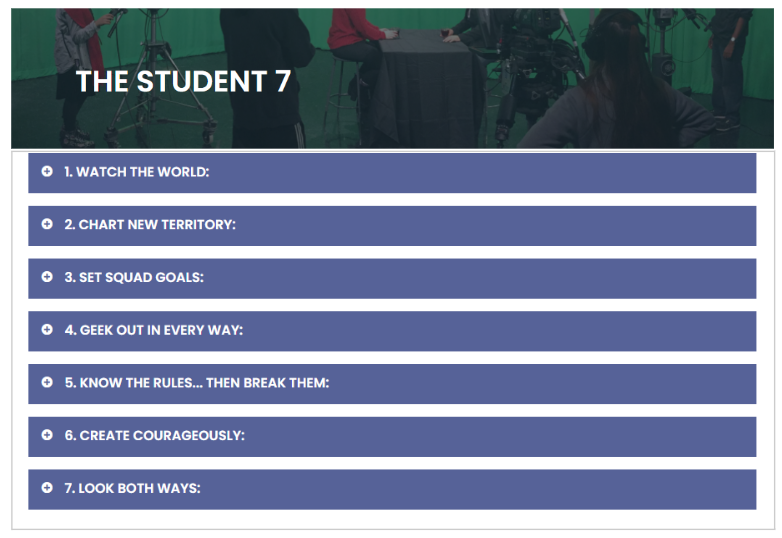
EDIT Media’s student and teacher resources were also commonly cited by instructors as a valuable resource in tone setting. EDIT’s Student 7, for example, provides guidance for integrating critical themes across group work, screenings, project expectations, and critique sessions:
This is something we created, a few faculty members in conversation with students. And it’s basically like a guide to being inclusive as a student, though we don’t frame it that way. It sets the expectations for how the class is going to be inclusive, like watch movies outside your comfort zone, watch genres you wouldn’t watch, watch films in your non-native language. It’s also about what it means to be a good collaborator in terms of respect and professionalism, but also about creating space for others to learn. I use that at the very beginning of the semester to be like “This is where I’m coming from, and this is why.” I lay out the statistics about who is in front of the camera in the industry (J. Proctor, Personal Interview, September 16, 2020).
As all instructors who spoke on this topic stressed, resetting the tone required diligent attention. The transmission model functions as the default for most pedagogy, especially in production courses in which technicist pressures are so pronounced. Against this pressure, instructors made sure to establish a commitment to critical aims at the beginning of the course, and to continually uphold that commitment through the tone of subsequent in class activities and project expectations.
Strategy 2: Process over Product
Once technical instruction does enter into consideration, instructors work to avoid the technicist trap through a process over product approach. Classroom goals here focus not on students reaching a certain standard in the work they make, but on thinking deeply on each step of the production process and its meaning-making value. Similar to the tone setting strategies mentioned above, many instructors look to disrupt the transmission/technicist approach by contextualizing the tools and skills students will encounter in class:
I talk a lot about how we’re using Adobe Creative Suite not because they’re the only or the best way to do things, but because most of the other ways to do things are in some way mimicking them. So knowing how to do them in this way can set you up with how to do things in other ways.
A.L. Nichols, Personal Interview, September 4, 2020
While Nichols exclusively teaches Adobe programs such as Photoshop, InDesign, and Illustrator in her graphic design courses, she often promotes alternatives to students who might not have the financial resources to afford Adobe’s monthly subscription rate:
I give them lists of open-source programs and what their equivalents are in terms of Adobe programs. But you need to know not that Adobe is the best, in fact I like GIMP better for a lot of things because I can automate scripts. But also because if you’re hired by a company, they’ll likely want you to be familiar with Adobe. They’ll want you to step in and open the Creative Suite and be ready to go.
A.L. Nichols, Personal Interview, September 4, 2020
These meta conversations about production technology and software also help instructors to get out in front of the technicist trap by denaturalizing the ‘standard’ transmission training model of most lab courses. For his reporting courses, Blaine introduces students to audio recording and camera equipment by avoiding a technical training approach, instead pointing to equipment as a vehicle for students’ storytelling ability:
I see all the tools not as end production tools but as notebook tools first. Like how does holding a camera in your hand teach you to observe better? How does being mic’d help you listen better?
M. Blaine, Personal Interview, August 20, 2020
Instructors used the process over product approach as a means of addressing the technicist imperative to equip students with job skills:
I mean I teach skills. But I am a big proponent of throwing them on their feet first. They may not have gotten all the skills they need yet, but that’s part of thinking on your feet. As you know, when you get hired for a job, you don’t know what you’re going to be asked to do. You have to be constantly thinking on your feet. You have to be ready to have things thrown at you. To me, media production is like a bunch of problem solving.
R. Goldman, Personal Interview, January 12, 2021
Another approach to stressing process over product was to justify the long term benefits of learning production and design concepts over discrete technical skills:
Me teaching you the trick way and not the basic tool, you’re just going to forget the trick later. If I teach you the five basic tools, you’ll still have that no matter what. And those basic tools transfer from program to program. And I emphasize that. It’s not about Adobe. It’s about these skills.
A.L. Nichols, Personal Interview, September 4, 2020
Learning specific functions in a program like Photoshop, as Nichols elaborates, might only be useful until the next update of the software comes out. A process-oriented approach, by contrast, gives students the adaptability to create effectively no matter the platform or tools. Critically examining the production process also helps instructors avoid the eventual byproduct of the transmission production approach: student work that reproduces hegemonic representations. In line with media literacy approaches, instructors avoid scolding students for their enjoyment of popular texts. They instead deployed the language of originality and creative storytelling to challenge students to tell new stories outside established forms:
I always start out the semester by telling them I don’t want to see what I’ve already seen before. You know, I just watched Scream, do I need to watch it again? Because you’re not doing it very well. They get it if you just say, not that aesthetic. I’m not going to limit your aesthetic, but I’m going to help you develop your own.
L. Vasquez, Personal Interview, October 28, 2020
Emphasizing originality, in particular pushing students to come up with an original process for creating media works, can also help to set more realistic expectations for what students can reasonably accomplish:
Like everyone wants to shoot a Marvel movie. I tell them very honestly, yeah they’re great movies. But you don’t have the budget to do that, and it’s gonna look like crap. But I can show you how to do something that’s gonna look really good. And then if you wanna go that route, go for it. Because we’ve got so many channels like Netflix, Hulu, Youtube, even the pandemic, that’s opened up a lot of opportunities for producers, especially documentaries. It’s easier to have a one-person band. And I try to tell them, try to do something you can master instead of imitating something poorly. Try to create something that’s yours.
O. Guerra, Personal Interview, November 2, 2020
Process over product here looks to move the goalposts around what counts as a ‘valuable’ job skill. As Boulton notes: “[It’s] not just training you for a non-existent industry job, but [getting] them started in establishing themselves, in their style from others.” A process-based approach also offers a way out from the transmission model of top down instruction, as Goodman details through his praxis-based method for teaching students how to record an interview:
I will say, yes, kids are automatically drawn to the technology. They love the camera, and learning to do the editing. And many have gone on to work in the industry in one form of the other. I don’t want to minimize that. But because it’s not our primary focus, it’s almost on a need to know basis. We don’t hand kids a manual that says this is how you do Premiere, read it and do it. Or here’s this particular camera. They learn it when we do it. We’d model some basic things with the camera, or how to hold the microphone like you’re doing an interview. Practice it a few times, then we’re going to go out and do it. And we’re gonna make a whole lot of mistakes. And then we come back and watch it, and through the mistakes you learn. You try to break down that fear of making mistakes, that thing that’s been hard wired into us in schools that you make a mistake, you get a bad grade. Here, no, that’s how you learn. The mistakes are discussed, so now we need to learn about lighting. What happened there? Oh he’s backlit. So what is backlighting? He’s in a shadow, you can’t see him. So what can you do to make it different? Or you did a great interview but you can’t hear it? Oh the mic was pointed toward the street. So how can you solve that problem for the next time?
S. Goodman, Personal Interview, October 29, 2020
This trial and error method helps students learn production techniques through their own experience, and connect how certain production choices affect meaning within the texts they create. Several instructors noted that transmission style instruction was often inevitable. The key comes in eventually clearing time to critically reflect on those technical concepts:
It may be that these hard skill building courses that incorporate how to use Premiere or the Adobe Suite, how to use this versus that piece of equipment, they may need to build that through multiple classes and contacts or by having the equipment themselves and by walking through the process. But my main goal is to turn that critical light switch on. To get them conscious of what they’re consuming. Not pressuring them to perhaps not continue to consume something, but to at least see this content from a different viewpoint.
J. Cubbage, Personal Interview, October 28, 2020
The process over product approach described and deployed here by instructors acknowledges the professional pressures and need to develop technical skills that drive the standard transmission/technicist model of production pedagogy. Yet it inverts the value system inherent in the technicist logic, placing technical skill development not as the end, but the means to develop one’s own production voice and vision.
Strategy 3: Resetting the Bar for Technical Skills
A technicist approach is often the unfortunate result of time restrictions, with building equipment or software skills being all students could handle in a given semester. In line with the process over product approach, many instructors combatted this issue by setting lower technical expectations in their classes:
I actually have to hold back technical proficiency. That’s the function of the parameters. Getting those ten 6-second clips, all you need is to make cuts. It puts everybody on a level playing field. Otherwise those who know how to edit will be putting on dissolves or wipes or slow-motion, then you have the student who just learned how to cut will be like “oh, mine wasn’t very good, because I didn’t have all that stuff.
P. Keating, Personal Interview, September 1, 2020
As Keating notes, lowering the technical bar holds a number of additional benefits, among them limiting the knowledge gap among students with differing levels of production experience (this need to address classroom power dynamics among students will be more fully explored in Chapter 5). Assigning smaller projects with more limited technical aims also makes it easier to focus on discrete technical elements in order to understand their meaning-making potential:
It’s not really (about working against conventions), it’s really about working against themselves. They just think that they know how to make things. Like I don’t allow them to use music, sometimes for the whole class, to cut to music. I’m really having them get to grips with film as a language. Like what are you saying?
A. Levine, Personal Interview, September 1, 2020
Having smaller, less-technically ambitious projects also serves to make in-class feedback sessions more valuable, a theme that will be more closely examined in Chapter 6:
What I want to do is make it as obvious as possible so that later they can start looking at stuff around them all the time that they never even stopped to think about, and say “oh wait, there’s camera angle again! Look how they’re using lighting!” So when we push it to that extreme, we can recognize these commonplace things as decisions that were made, and that decision is more likely to make me feel a certain way.
J. Share, Personal Interview, September 15, 2020
Beyond setting smaller technical goals, Proctor notes the value of making projects iterative in order to demonstrate for students how individual skills and production steps work together in practice:
I typically have some smaller projects and then a larger final project. In the advanced class, they’ll have more flexibility over that final. In the intro, I scaffold a series of assignments that get put together into a short film at the end of the semester.
J. Proctor, Personal Interview, September 16, 2020
In line with his trial and error based method, Goodman begins production training not by giving students equipment, but by modeling practices through storyboarding and doodling activities:
Very often, we think of doodles as singular activities, but I think you can doodle a collaborative film project, just by getting a rough sketch of what they’re supposed to do. They can get a sense of “oh, we drew a close-up, but when we edited it together, it looks really bad there.” They’re getting a chance to see that before they jump into the larger project, but they’re also seeing what they’re supposed to do.
O. Keyes, Personal Interview, January 8, 2021
Avoiding the technicist approach of mastering discrete editing or framing techniques allows Goodman’s students to create an understanding of technical practices as modes of personal expression. To better illustrate the lower tech approach in practice, I want to spotlight a syllabus for Guerra’s 200-level Moving Image & Sequence course. At first glance, the language of the syllabus seems well in-line with a technicist approach to production, outlining a set of technically-oriented goals including “gain(ing) technical expertise in configuring and operating video editing software, including importing various source files.” Further, the only book required for the course is Jago’s Adobe Premiere in a Classroom, an Adobe-produced text based around transmission style step-by-step tutorials. For Guerra, this initial emphasis on nailing down a basic level of technical proficiency is a matter of accountability to his students:
I want to make sure you know how to use the camera and a basic lighting triangle. Because there might be an opportunity to get a job in commercials or non-profit. So I try to teach classes that are going to give you enough flexibility for you to use the cameras in different ways.
O. Guerra, Personal Interview, November 2, 2020
Yet the small scale of the technical goals Guerra sets opens up the space necessary for critical work to occur. For the six video production assignments in the class, none is longer than one minute. The short duration of assignments also reflects their narrow scope. For example, one late semester assignment focuses just on mastering the continuity editing technique of match on action:
So for matching action, I don’t care about the story. It’s just about showing that you know the rule with your sequence. The more little assignments you have, the more engaged they are as opposed to one big final project where they’ve just been reading and taking quizzes.
O. Guerra, Personal Interview, November 2, 2020
While Guerra asks students to pay attention to a whole lot of technical concepts in the Matching Action assignment rubric—picture quality and focus, visual composition, pacing, continuity of action, avoidance of 180° rule and jump cut issues, shot variety—the assignment itself only comprises three shots. Maintaining these standards over the course of a short film might easily overwhelm a student; however, the task is a whole lot more manageable for a sequence less than 10 seconds in total length.

Further, the close focus on such a short sequence allows Guerra to contextualize concepts like continuity or 180° rule not in the technical language of right and wrong practices, but in more critical terms of meaning-making:
You learn the basics. Then if you’re breaking the rule with a purpose, you’re doing something really cool. You have to learn your basics, you have to learn how to frame a shot, and then you can do whatever you want with it.
O. Guerra, Personal Interview, November 2, 2020
Potentially the most interesting example of Guerra’s resetting of the technical bar is in the final assignment, a one minute video tutorial on a subject of the student’s choosing. For many video production classes, this sort of tutorial assignment would likely serve as an early semester warm-up, a bit of camera practice on the way to a more ambitious narrative or documentary project. However, elevating this small scale assignment to the final instead allows Guerra to direct closer attention to each component of the project.

Figure 3.4: Description of final Video Tutorial assignment from Guerra’s Moving Image & Sequence course.
In a clever bit of synthesis, the tutorial requires that students apply skills from all the previous assignments. They must reflect on how they used audio voiceover, match cuts, montage editing in previous projects, and think about how they will deploy them all together in the finished tutorial assignment. And while most early projects in Guerra’s class focus on developing individual technical skills, the final assignment Video Tutorial assignment aligns with the Freirean goal of letting students express personal expertise. Guerra’s students express their own expertise beyond technical production skills by showing off their ability to make cold brew coffee, design an original character in Illustrator, or install a fuel gauge in a Saab 9-5.
The restrictions open up space for reflection to happen. For Guerra and other instructors, it’s not about sacrificing technical or critical goals: it’s setting smaller, manageable ones, such that there’s time for reflection after the action of production.
Strategy 4: Challenging Production Standards
Disrupting the technicist/transmission approach also meant challenging standard production practices. For many instructors, this challenge began by rejecting the idea of learning to operate equipment or software in a ‘correct’ way:
My first step when I open Adobe, I tell them to watch me move this window. Then I say take thirty seconds and make this look as messy as you possibly can. Before they’ve even learned that it can edit videos, they’ve broken Adobe. Then I show them where the reset button is, which I didn’t know about until my third year of film school. I think it’s better to teach those technical skills knowing that mistakes are going to happen and giving them the skills they need to encounter it. Equipping them with troubleshooting and critical and information skills. How do you search for something? How do you learn to read software? Because if they can read one Adobe program, you can learn the others pretty easily as well. But if you teach it as “this is the specific way to do a specific thing” they’ll never be able to open up Illustrator and fuck around.
O. Keyes, Personal Interview, January 8, 2021
Instructors deployed these critical approaches to production training in different formats, most commonly through a walkthrough lecture format. Working individually on lab computers, students guide students through a technical operation such as color balancing an image or trimming a video clip by modeling the task on a projected display. These walkthroughs are typical of a transmission/technicist model on pedagogy. Yet to break up the top-down orientation of this approach, instructors often build in opportunities to play and explore the tool. As Keyes articulates above, allowing students to “fuck around” prioritizes self-efficacy over proficiency. Inviting mistakes also works to prioritize students’ creative use of tools:
People understand that when they see a sequence of shots, that didn’t happen magically; it was premeditated. So when the students hear about what the intentions of a project are supposed to be, the production things can be talked about in a way that’s prescriptive, or say that’s really cool you did it that way. Or they can say “oh, you violated the 180 degree rule, but here’s why it does or doesn’t work here.
K. Oppenheim, Personal Interview, August 24, 2020
Questioning production standards offered during technical training sessions serves to root critical discussions of power and representation at the site of production:
I try to imbue any technical conversations we have with elements of a critical example. Even with editing, we’ll try to build in a conversation about how even interfaces/technologies are not neutral. There’s always some way the technology is nudging you in one direction or another. Even something like a transition, how does that become meaningful? What happens when you make a cut from one shot to the next. It helps to bring in Eisenstein and Kuleshov. It’s not just a cut because it creates action, it’s a cut because it creates a juxtaposition, and within that juxtaposition, there’s a meaning. Even if you’re doing continuity editing, you’re creating some sort of juxtaposition.
J. Proctor, Personal Interview, September 16, 2020
The technology “nudging” students toward certain production choices was a concern noted by several instructors. The Adobe production programs that most instructors used in their classes often include in-software tutorials allowing for self-directed learning. While potentially helpful for instructors looking to offload production training and focus their own teaching on critical concepts, these tutorials are embedded within the technicist logic of reproducing “best practices,” and act as one of the most silent and powerful means by which the transmission model is reinforced through production pedagogy. Instructors here emphasized the need not only to deliver these technical training sessions themselves, but to rework the process of teaching technical skills in order to open up space for critical consideration and new practices to emerge:
I’ll take it back to a small technical thing then apply it to the large cultural thing. A thing I will do in my teaching around race–and I think it’s really important to embed these lessons in the technical instruction as much as we do the conceptual–when I teach exposure, I will talk about Shirley cards. I’ll talk about how you have to know how to light people with darker skin tones, otherwise it makes you a shitty cinematographer. I will embed it in their evaluation of their technical skills if they can’t shoot different skin tones. And so it makes it where any time they hold a camera at somebody, they have to think about race in this critical way. And they’re like “I’m not a good filmmaker if I can’t light someone with darker skin tones,” because the camera has a bias. And that’s been incredible to watch especially my college students where they’re becoming better in a technical skill set with this cultural understanding, and becoming better filmmakers. This technical skill benefits from knowing how to light someone that’s not white.
O. Keyes, Personal Interview, January 8, 2021
Keyes’ approach reinforces the strategy of resetting the tone by positioning cultural understanding as a part of the production process: necessary to students’ own success as filmmakers rather than a roadblock to their skill development. For Goldman, attending to the tone is a matter of establishing a new standard practice, one in which critical considerations inductively inform and guide production decisions:
I don’t have one class where I’m like “now we’re going to talk about diversity, equity, inclusion.” It is integrated into my pedagogy and my curriculum. It comes up organically and I address it organically. I teach Women and Gender Studies and LGBTQ studies, and I think teaching those helps me bring those issues into my classes. As much as possible, I try to normalize all of these things. You can talk about it as queering, but I don’t find that particularly useful. Just like racism and sexism and homophobia and classism and ableism, they underlie these structures. I guess it’s my goal to push these very important issues of equity and inclusion into the very structures of the pedagogy of teaching media production.
R. Goldman, Personal Interview, January 12, 2021
Other instructors opted to record their own training videos, allowing for self-directed learning while not losing critical concepts. Lab settings, by nature of limited computer stations, also offer opportunities for one-on-one engagement with students:
I do spend a lot of time in the editing room with my students. We are always thinking about and talking about what’s the purpose of that cut. How does that cut frame, help, change, tell/not tell your story? What is the purpose of what you’re doing? I do a lot of that.
L. Vasquez, Personal Interview, October 28, 2020
Key in all of these approaches is a hands-on approach to teaching technical skills in a manner that opens up the production process to deeper critical and creative considerations. How instructors work these considerations into their courses is a matter that will be given much deeper attention in the subsequent chapters; however, at this initial stage, challenging the established transmission/technicist mode of production education is necessary if CMPP approaches are to take root.
Strategy 5: Negotiating with the Software
Masterman’s (1985) notion of the technicist trap points to one of the specific issues that instructors face in blending critical pedagogy and media production. The onus to train students on complex production equipment and software pulls instructors into the trap, such that coursework is often reduced to vocational training. Since the time of Masterman’s writing, production software has assumed a central role in production classrooms. Many universities market their courses specifically around building aptitude with a certain program or make faculty hiring decisions based on candidates’ mastery of various software. Students enroll in production courses with the expectation that they will gain a working knowledge of software rather than the generalized skill. A graphic design course acts as a vessel for learning InDesign, or an animation class becomes a means to learn After Effects. The software and the skill become synonymous.
A further complication for instructors looking to avoid the technicist trap is that many programs–those in the Adobe Creative Suite used most heavily in higher education production courses in particular–now can teach themselves. The video editing program Adobe Premiere, for example, defaults to its ‘Learning’ module upon first opening. Built-in tutorials on importing media, using the timeline tool, and applying color effects walk users through basic operations of the program, in effect ensuring that the transmission/technicist approach is automatically inscribed into the production process (Swerzenski, 2021). The challenge of how to overcome the technicist trap when the tech itself is actively pulling them back into it is one that has been among the most difficult for me as a production instructor. Interviewees for this project also spoke at length to their own struggles with classroom tech. Many have also formed canny tactics for negotiating with/against production software to find space for critical considerations.
One common tactic was to encourage students to experiment within the software. Against the default in-program tutorials which aim for mastery, the charge to experiment aims to build different expectations for students’ use of the tool:
(I) have them look at editing as an experiment, as a language we take for granted but that does come out of an experimentation with a kind of visual language… Film is an experiment, montage is an experiment.
A. Levine, Personal Interview, September 1, 2020
Like Levine, many instructors that championed this experimental approach to software came from art school backgrounds. Having not been trained in production software through the transmission/technicist approach standard in most Communication-adjacent programs, they model for students a different relationship with software. Learning goals center not on learning a program efficiently or developing best practices in it, but in growing comfortable enough with its functions to express oneself clearly and creatively through it. In line with tone-setting goals, these instructors advocate holding experimental sessions with software frequently. Small, ungraded in-class projects also serve to reduce the technicist pressure of doing something wrong:
Especially when you’re working with young people, but even all students, we want a sense of closure, of doing and feeling something and demonstrating something. So we’ll do a quick little podcast assignment. Take out your cell phone, sit down with two other people, write a little script, and sell a product. Use these techniques; you’ve got 15-minutes to do it… I try to (have them) create some piece of media every class. Go online, create a meme. Create a poster.
A.L. Nichols, Personal Interview, September 4, 2020
Instructors like Nichols showed a keen awareness of the technicist pull, particularly on students. In situating critical discussions and reflection periods in her courses, she is careful not to make these activities feel like an interruption from production work. For her Digital Design class, she instead negotiates with in-class software to find natural spaces for critical consideration:
It takes awhile for us to get to InDesign. It takes like 7-minutes for it to open. They also made a change recently where every student has to logon with their own ID. So I use that loading time to my advantage. I talk to them for the first 7-10 minutes. The program can’t be on yet because it’s still loading. I lecture about theoretical content then.
A.L. Nichols, Personal Interview, September 4, 2020
The subsequent “lecture” Nichols describes is in fact a discussion session with her students meant to get them critically reflecting on questions of design in the moments before they start using the design tool. She grounds her lesson in accessibility in design by getting students to consider accessibility issues they encounter in everyday life:
I ask them questions and write their answers on the white board. So we’ll start with a question like “what happens when I’m designing something like the cafeteria down the hall, and I’m pretty used to being able to use my arms and legs all the time.” So I figure I’ll design this cafeteria so that you have to turn a door knob, push open a door, go down four stair, go around a corner, then pick up a tray, hold the tray with one hand while you put silverware on it with the other, and then walk over here and balance the plate. And by that time, they’re laughing, because five of them might be on crutches from football injuries. So then I ask, do you think if I were a football player who was on crutches at some point during the year, I would design the cafeteria differently?
A.L. Nichols, Personal Interview, September 4, 2020
Though cafeteria discussion here acts as an entry point to the main thesis of Nichols’ design lesson on the ethical imperative for designers to think beyond their own lived experiences when making production choices:
It’s not that I hate football players when I design, it’s that I didn’t imagine football players. We as designers make those same mistakes. And then we start to think through, what about people who are red/green color blind? What about issues of contrast? Who are we designing this for? What if you associate these colors with this thing, but this other person associates them differently? How do you find these things out? So we have these types of conversations, and repeatedly in different ways about different aspects of design as we’re learning about them. We have them about color, we have them about typefaces and readability, we have them in the trifolds about audiences, we have them with the book covers about positionality, and we have them when we’re making the posters about ideology and power.
A.L. Nichols, Personal Interview, September 4, 2020
Another tactic for challenging the technicist approach while teaching software was to challenge the perceived value neutrality of these programs. Denaturalizing ‘standard’ production conventions and the role software plays in reproducing these conventions can open up opportunities to create a different engagement with the tool than those inscribed in built-in tutorials and other technicist materials:
I approach it in a really queer way. Like Adobe is trying to sell you a product when it builds a tutorial. It’s not going to tell you what’s quirky about the software, it’s not going to tell you that some parts of the interface don’t really make sense, or that you can move things over in different ways. They’re not going to tell you what happens when you do something wrong, because they’re trying to tell you how to not do something wrong. You don’t encounter mistakes in their instructional materials. And what I will do intentionally is practice my mistake making. I’ll go into a lesson knowing I’m going to fumble this on purpose, just to see what happens. And sometimes it happens on a whim, like Adobe will update right before class. And I’ll embrace that as part of the process, because they’ve seen this mistake making throughout the class. They’re not frustrated when they encounter something going wrong; they meet that error.
O. Keyes, Personal Interview, January 8, 2021
Against the transmission/technicist style of building discrete skills through tutorials or step-by-step walkthrough, Keyes’ embrace of mistakes looks to build student confidence. Beyond the self-efficacy to overcome technical issues when they arise, this messier, experimental approach also induces students to use (and possibly abuse) the software on their own terms. For in-class editing sessions, remix projects act as a powerful vehicle for Keyes’ approach:
I introduce software through remix. That’s where a lot of my practice as an artist comes from. So when I go through Adobe, one of the things I’ll do with kids is take the Buffy the Vampire Slayer music, and we’ll remix it with whatever fem-heroine movie just came out. They’ll take the trailer, shorten it down to 60-sec., put it to music, and they’re learning all the skills as an in-class, technical exercise that showing them where things can get kinda quirky, where their main key buttons are, and it’s giving them in class time to explore that together.
O. Keyes, Personal Interview, January 8, 2021
For the remix and all other in-class editing activities, Keyes doesn’t shy away from providing technical instruction such as walkthroughs to ensure students are familiar with certain Premiere functions. In these cases, he emphasizes the need for an active instructor, one who doesn’t leave students to learn technical skills from outside materials or the tool itself:
I see that so much in technical instruction, where it becomes the student responsibility to teach themselves. And that’s great if all we want is more white boy editors. My goal is to get more diverse editors, to get more women into editing, to get more queer folks in editing. And so that means in-class technical instruction with a guided exercise is a thing to do, and that exercise should relate to your practice, because that’s what you’re going to teach the best.
O. Keyes, Personal Interview, January 8, 2021
In line with the earlier process over product strategy, Keyes’ advocacy of hands-on technical instruction looks to ensure software training doesn’t slide into the technicist trap: contextualizing technical instruction, reiterating critical themes throughout the process, and offering support for students with different capabilities and confidence levels. Though similar artists’ sensibility informs much of Keyes presentation of Premiere and other software to his students, he offers Queer and Glitch Studies as valuable frameworks for reimagining technical mishaps, experimentations, glitches as creative opportunities:
Sometimes if I’m feeling particularly cheesy, I’ll talk about your machine glitchy as it’s trying to make art with you, it’s trying to participate. It’s what Bennett calls useful anthropomorphism. I do that with computers all the time. I have some witchy, magic-y students who might interpret glitch as a sign. Like they’ll go in a completely different direction because I encountered an error. And I’m like “dope.” As long as it happens you’re not like “everything is terrible and life is ruined.” It’s this other way of moving through it that’s very queer and less perfectionist. That’s how the Adobe industrial model has it: these are the standards of production. That’s great in a certain context for certain people at a certain level. It’s really inaccessible for other groups. I want people who aren’t tech people making things with tech, because the way they’re going to encounter it is going to be so different. That’s where all the cool stuff comes from!
O. Keyes, Personal Interview, January 8, 2021
Avoiding the technicist trap in software training, as Keyes and other instructors demonstrate, cannot avoid technical training. Yet in teaching editing and other skills, their approach rejects the technicist/transmission emphasis on perfectionism. In its place, they model for students a relationship with software built on experimentation and play, one that places personal expression over technical proficiency.
Discussion
Challenging the transmission approach must first acknowledge the pressures that have kept it in place. Production courses are popular among students and departments for the job-ready skills they provide. Ignoring these imperatives, as many instructors expressed, is to avoid accountability for students, who will need technical skills to compete in the professional world. Resistance to the transmission/technicist model as practiced by the instructors here takes an institutional rather than a radical approach: not dropping technical skill-building as a teaching goal, but rearticulating the manner and context in which skills are taught.
Instructors argue for a reframing of the tone around production instruction, one that takes the time to establish the value of critical concepts within rather than separate from the production process. They utilize lower technical goals, stopping the rush to have students master equipment in order to complete ambitious final projects. Assigning smaller, iterative projects clears classroom time for critical reflection. Slowing down also helps to isolate specific aspects of the production process and understand how individual technical choices affect meaning. They approach technical skills and critical concepts as equally important aspects of students’ production toolkit, with skills such as lighting a scene requiring cultural sensitivity to skin-tone as well as the camera know-how needed to adjust for these differences. As McLaren (2003) notes, these activities move “beyond the technological correctness of what computers can and can’t do” and toward contextualizing production choices alongside considerations of class, gender, and race equality (p. 442). Cumulatively, these strategies challenge the logic at the core of the technicist/transmission approach that has kept production courses as a site of industry job training within universities.
This institutional approach also limits the degree to which these strategies uphold many critical pedagogy ideals. First, instructors here mostly maintained the top-down orientation central to the transmission model. Even if the tone they strike is more critical than in standard production courses, that tone is still set by the instructor. Further, strategies such as process over product aim primarily at getting students to think more critically about the technicist approach, rather than offering a distinct alternative to it. Resetting the bar through project parameters or challenging software are similar efforts to squeeze a bit more critical reflection and theoretical consideration within primarily tech and skill focused classes.
To view the institutional approach offered here as watered down critical pedagogy is a fair critique. Yet given the deeply embedded technicist framing within most production instruction along with the myriad institutional pressures that uphold it, these small moves to unsettle the status quo I believe have outsized value. To this end, challenging the transmission approach comes through the process of denaturalizing it: holding dialogue with students that contextualize the value of standard and non-standard production approaches, and creating classroom conditions in which students are empowered to play with standards to best benefit their own expression. These more adaptable production skills, based on conceptual understanding rather than technical mastery, can serve students in a variety of contexts, both in professional life and beyond.
